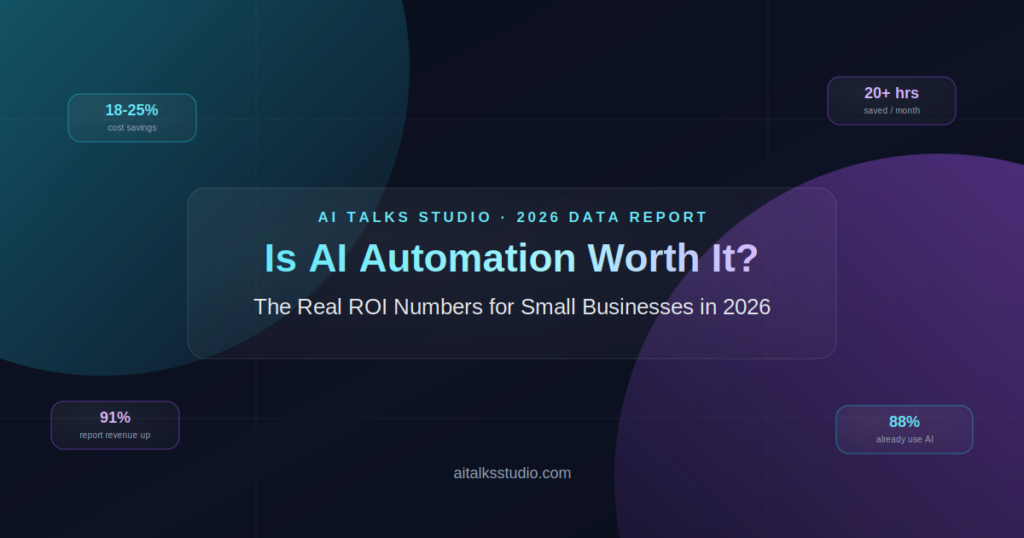
“Is AI automation actually worth the money, or is it just hype?” — it’s one of the most common questions business owners ask before automating anything.
So instead of opinions, here’s the data: real, sourced numbers from McKinsey, Gartner, Forbes, and Salesforce on what AI automation is actually doing for small businesses in 2026 — the savings, the ROI, and where it tends to fail.
AI Adoption Is No Longer Early — It’s Mainstream
AI agents have moved past the experimental stage. According to McKinsey’s State of AI research, 88% of organizations now use AI in at least one business function — up sharply from just 20% back in 2017.
The shift toward autonomous “agentic” AI specifically is accelerating even faster. Gartner forecasts that 40% of enterprise applications will embed task-specific AI agents by the end of 2026, up from under 5% in 2025 — one of the fastest technology adoption curves on record.
For small businesses, the picture looks similar. 58% of small businesses were using generative AI as of 2026, up from 40% in 2024, according to U.S. Chamber of Commerce data.
What AI Automation Actually Saves Small Businesses
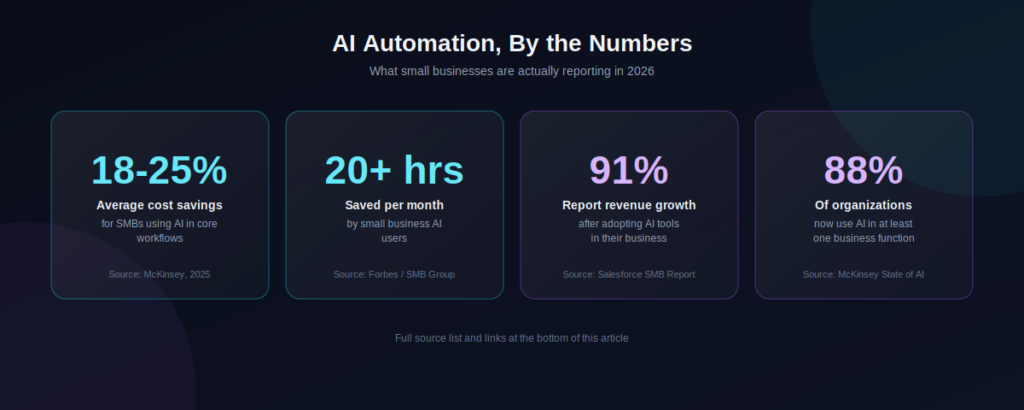
Here’s what small businesses are reporting after adopting AI automation:
- 18–25% average cost savings for businesses that integrate AI into core workflows, according to McKinsey 2025 data
- 20+ hours saved per month for small business AI users — roughly half a full-time employee’s capacity, per Forbes and SMB Group research
- $500–$2,000 in monthly savings reported by nearly two-thirds of SMBs using AI, money that’s typically reinvested into growth rather than pocketed
- 91% of small businesses using AI tools report a measurable increase in revenue, not just cost savings, according to Salesforce’s SMB Trends research
In short: the savings are real, but they show up in two forms — money saved on operations, and revenue gained from doing more with the same team.
Where the ROI Actually Comes From
Not every department returns the same value. Based on current industry-reported figures, ROI tends to concentrate in a few specific areas:
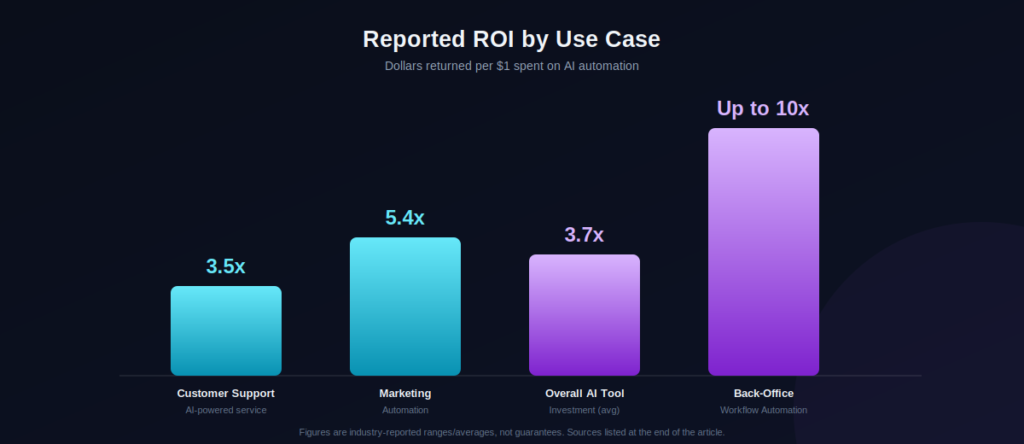
- AI Customer Support — Roughly $3.50 returned for every $1 invested in AI-powered customer service, driven by faster response times and fewer missed inquiries
- AI Marketing Team — Marketing automation averages about $5.44 back per $1 spent, one of the most measurable ROI categories in small business tech
- Workflow Automation — Back-office automation (invoicing, data entry, reporting) sees the highest ceiling, with some businesses reporting 400–1,000% ROI since it removes pure labor cost with minimal added complexity
- Overall AI tool investment — Across all use cases combined, McKinsey estimates an average return of roughly 3.7x per dollar spent
The pattern is consistent: repetitive, rules-based, high-volume tasks return the fastest and highest ROI — which is exactly what an AI workforce is built to handle.
The Honest Part: Why Some AI Projects Still Fail
To be fair to the data, not every AI initiative succeeds. Gartner also predicts that over 40% of agentic AI projects will be cancelled by the end of 2027 — not because the technology doesn’t work, but because of unclear business value, poor planning, or a lack of proper integration and oversight.
This is the gap between businesses that see real ROI and those that don’t: it’s rarely the AI itself that fails — it’s the implementation. Generic chatbots bolted onto a website without a real strategy behind them tend to underdeliver. AI agents built around an actual understanding of a business’s workflows tend to succeed.
How Ghost Workforce™ Turns These Numbers Into Reality
This is exactly the gap AI Talks Studio’s Ghost Workforce™ framework is built to close. Instead of a single generic chatbot, we build department-specific AI agents — for HR, sales, finance, support, and more — that are trained on your actual business processes, not generic templates.
That’s the difference between an AI experiment that gets cancelled and an AI workforce that pays for itself in months.
How to Get Started
- Book a free discovery call so we can map your highest-cost, highest-volume manual tasks
- Get a recommendation on which department returns ROI fastest for your specific business
- See your AI agents built and deployed — most single-department agents go live in days
Frequently Asked Questions
For most businesses, yes — small businesses using AI report average cost savings of 18–25% and time savings of 20+ hours per month. The key is targeting the right task: repetitive, high-volume work returns the fastest ROI.
Most well-scoped AI automation projects reach positive ROI within 3 to 6 months, according to industry benchmarks, though this varies by task complexity and how many systems need to be connected.
Unclear business value and poor implementation — not the technology itself. Gartner projects over 40% of agentic AI projects will be cancelled by 2027 for exactly this reason, which is why a tailored build matters more than a generic tool.
Customer support, marketing, and back-office/workflow automation tend to show the fastest, most measurable ROI — but the right starting point depends on where your business currently loses the most time or money.
Ready to See Your Own ROI Numbers?
Let AI Talks Studio show you exactly where AI automation would save your business the most.
Sources
- McKinsey — The State of AI, 2025
- Gartner via Salesmate — AI Agent Adoption Statistics by Industry
- Gartner via SQ Magazine — AI Agents Statistics 2026
- Forbes / SMB Group via Capsule CRM — Small Business AI Adoption Statistics
- McKinsey via theStacc — Small Business AI Adoption: 52 Stats
- U.S. Chamber of Commerce via DeanTek — AI Automation for Small Business Statistics