Small businesses in 2026 are facing a familiar problem: too much work, too few hands, and rising labor costs. Enter the AI employee. a term that’s quickly becoming one of the most searched phrases in small business technology.
But what exactly is an AI employee? Is it a chatbot? A piece of software? A replacement for human workers? In this guide, we’ll break down exactly what an AI employee is, how it works, real-world use cases, and how small businesses can start using one without a massive budget or technical team.
By the end of this article, you’ll understand whether an AI employee is right for your business, and how to get started.
An AI employee is an autonomous or semi-autonomous software agent powered by artificial intelligence that performs tasks traditionally done by human staff, such as answering customer emails, scheduling appointments, qualifying leads, managing social media, processing invoices, or handling customer support, without needing constant human supervision.
Unlike a simple chatbot that follows a rigid script, an AI employee can:
Think of an AI employee as a digital team member — one that’s hired, trained (or configured), and assigned responsibilities just like a human hire, except it runs on software instead of a paycheck.
This is where a lot of confusion happens. Here’s a simple breakdown:
| Feature | Traditional Automation | Chatbot | AI Employee |
|---|---|---|---|
| Follows fixed rules | Yes | Mostly | Sometimes |
| Understands natural language | No | Yes | Yes |
| Makes independent decisions | No | Limited | Yes |
| Handles multi-step tasks | No | No | Yes |
| Learns and improves | No | Limited | Yes |
| Works across multiple tools | Rarely | Rarely | Yes |
A chatbot answers questions. An AI employee completes work.
Several forces have converged to make 2026 the breakout year for AI employees among small businesses:
Hiring, training, and retaining staff has become more expensive. An AI employee can take on repetitive or time-consuming tasks at a fraction of the cost.
Customers expect instant responses. An AI employee doesn’t sleep, take weekends off, or need time zones considered.
AI models have become significantly more accurate and dependable at handling real business tasks — from customer support to data entry — reducing the risk of costly errors.
You no longer need a developer to set up an AI employee. Many platforms offer no-code or low-code setup specifically designed for small business owners.
Businesses that adopt AI employees can respond faster, operate leaner, and scale without proportionally increasing headcount — putting pressure on competitors to keep up.
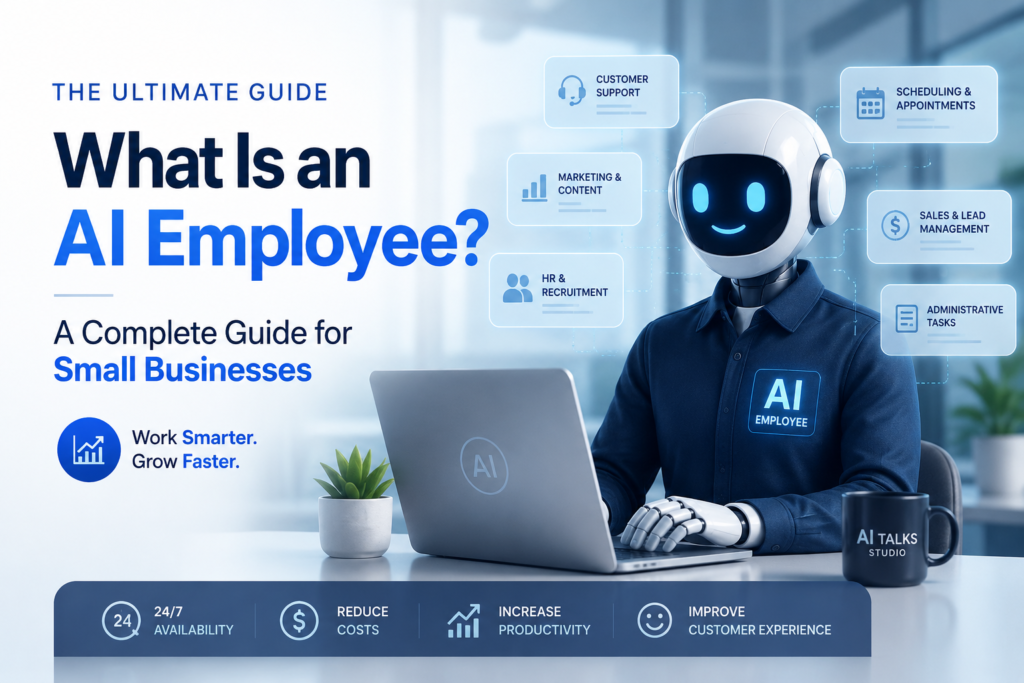
Here are the most common roles small businesses are assigning to AI employees in 2026:
Most small businesses use AI employees to supplement, not replace, their teams — handling repetitive tasks so human employees can focus on strategy, relationships, and complex problem-solving.
Many platforms now offer subscription-based pricing designed specifically for small budgets, often costing less than a part-time employee’s monthly wage.
Reputable AI employee platforms include human-in-the-loop safeguards, allowing a person to review or approve sensitive actions (like refunds or contracts) before they’re finalized.
Look for platforms with clear data privacy policies, encryption standards, and compliance certifications before onboarding an AI employee into your workflow.
As we move further into 2026, AI employees are expected to become more specialized, more affordable, and more deeply integrated into everyday small business tools like CRMs, accounting software, and e-commerce platforms. Businesses that adopt early are positioning themselves to operate leaner and respond faster than competitors still relying entirely on manual processes.
An AI employee isn’t science fiction — it’s a practical, increasingly accessible tool that small businesses are using right now to save time, cut costs, and grow faster. Whether it’s answering customer questions, qualifying leads, or handling admin work, an AI employee can become a reliable member of your team without the overhead of a traditional hire.
The businesses that succeed in 2026 won’t necessarily be the ones with the most employees — they’ll be the ones who know how to combine human talent with AI employees effectively.
An AI employee is a software-based worker powered by artificial intelligence that performs tasks like customer support, scheduling, or data entry, similar to a human employee but without needing a salary or supervision.
Costs vary by platform and use case, but many AI employee tools are priced as monthly subscriptions, often significantly less than the cost of hiring a part-time human employee.
Yes. Most small businesses use AI employees to handle repetitive tasks while human staff focus on higher-value work like relationship-building and decision-making.
No. A chatbot typically answers questions based on scripts, while an AI employee can complete multi-step tasks, make decisions, and work across multiple business tools.